

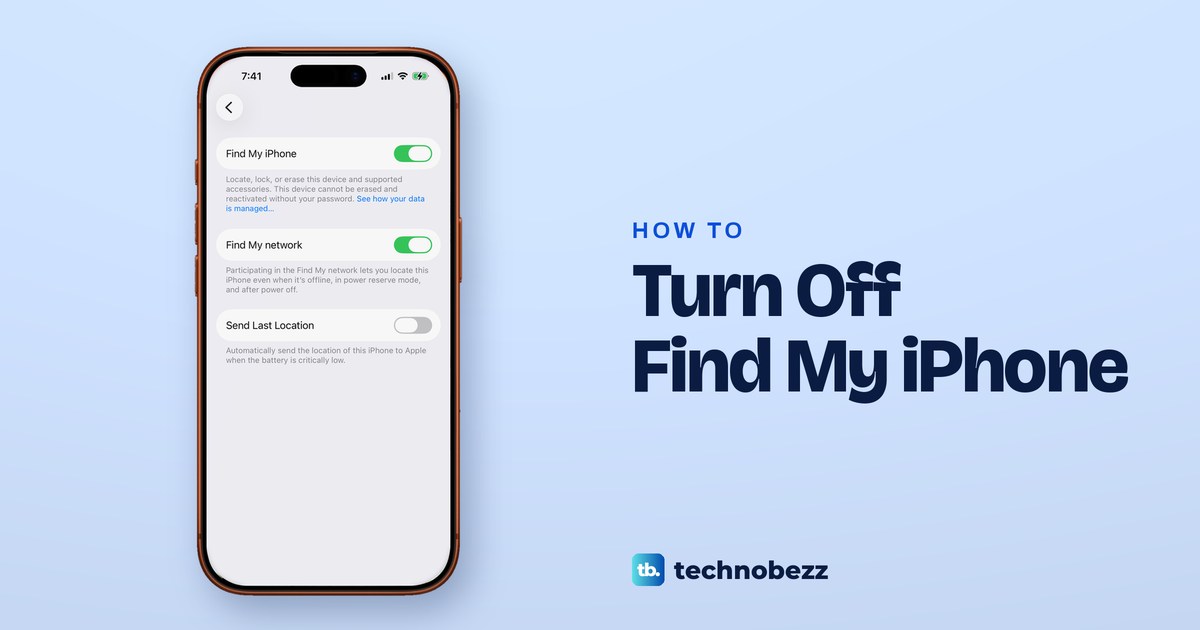
To turn off Find My iPhone, open Settings, tap your name, tap Find My, then Find My iPhone, and turn the switch off. Enter your Apple Account password and tap Turn Off. Apple says this also removes Activation Lock, so the phone can be erased, sold or set up by someone else.
The short version
- On the iPhone: Settings, your name, Find My, Find My iPhone, switch off, then your Apple Account password.
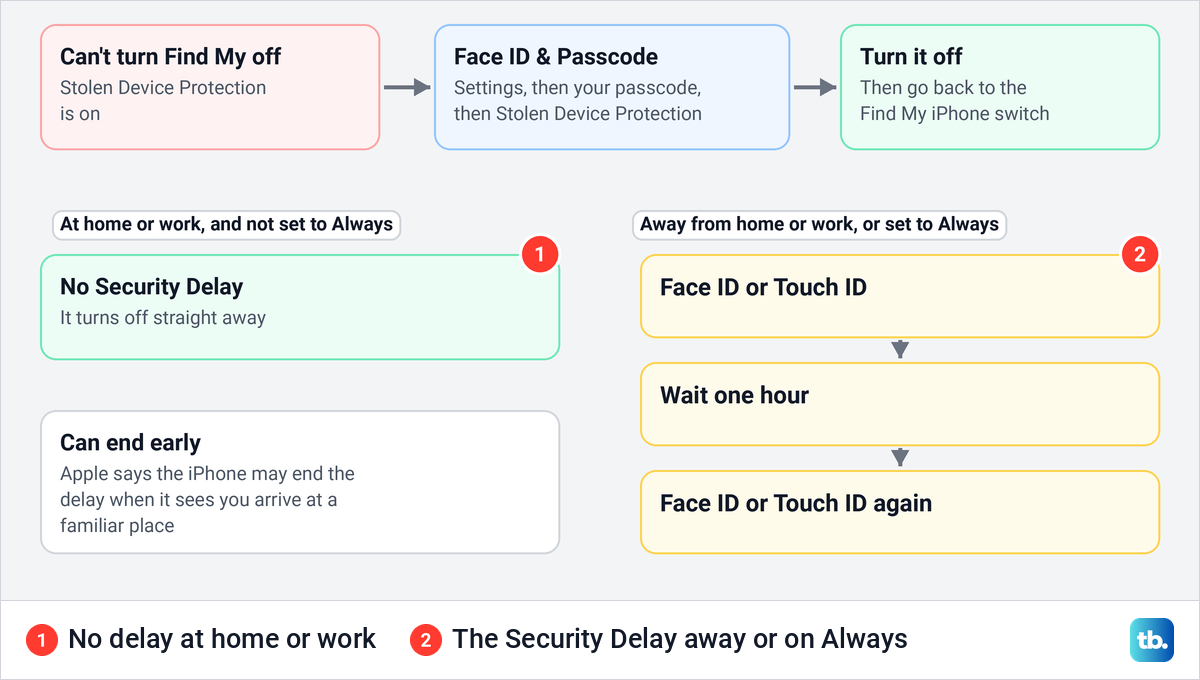
- Can't turn it off? Turn off Stolen Device Protection first. Away from home or work, or with it set to Always, that can mean a one-hour wait.
- Phone broken and offline? At icloud.com/find, choose Remove This Device. Already sold it? Erase This Device first, then Remove This Device. If it is lost or stolen, mark it as lost instead and do not remove it.
- Selling it? Erase All Content and Settings turns Find My and Activation Lock off for you.
- Repair on iOS 27 or later? For an eligible repair, turn on Ready for Repair or Trade In in the Find My app and leave Find My on.
Two things can get in the way. If you cannot turn the switch off, check Stolen Device Protection first, because Apple does not let you turn Find My off while it is on. If the phone is broken or already gone, you can do it from a computer instead, and what happens there depends on whether the iPhone is online. A lost or stolen phone is the exception: Apple says to mark it as lost and keep it in Find My.
Which way to turn off Find My iPhone
Pick the row that matches your situation. If you have the phone and know the password, the first row is all you need.
| Your situation | Where to do it | What happens |
|---|---|---|
| You have the iPhone and know the password | Settings > your name > Find My > Find My iPhone, switch off, password, Turn Off | Find My is off and Activation Lock is removed |
| You cannot turn the switch off | Settings > Face ID & Passcode > Stolen Device Protection, off | Then you can turn Find My off, after a one-hour delay if you are away from home or work, or if it is set to Always |
| The iPhone is lost or stolen | icloud.com/find > your iPhone, mark it as lost | Do not remove it, because Apple says removing it makes it easier for a thief to resell |
| The iPhone is broken or switched off and not coming back | icloud.com/find > your iPhone > Remove This Device | Activation Lock is removed now and the phone leaves your list after 30 days |
| The iPhone is still online but out of reach | icloud.com/find > your iPhone > Remove This Device > Continue | It is not removed, only marked Ready for Repair or Trade In for 30 days |
| You already sold or gave it away | icloud.com/find or the Find My app, Erase This Device, then Remove This Device | The phone is wiped and the new owner can set it up |
| You still have it and are selling it | Settings > General > Transfer or Reset iPhone > Erase All Content and Settings | Erasing turns Find My and Activation Lock off |
| It is going for repair on iOS 26 or earlier | Settings > your name > Find My > Find My iPhone, off | Apple might not service it if Find My is on |
| It is going for repair on iOS 27 or later | Find My app > your iPhone > More > Repair or Trade In > Enable | Find My stays on during an eligible repair |
| You only want to hide your location | Find My app > Me > Share My Location, off | Find My iPhone stays on, because it is a separate switch |
The offline and online rows are where most advice goes wrong. Apple's iCloud guide says Remove This Device clears Activation Lock straight away only when the iPhone is offline. For a phone that is online and no longer yours, erase it remotely first, which wipes everything on it.
Turn off Find My iPhone in Settings
Apple's steps are the same in its iOS 26 and iOS 27 guides. You need the password of the Apple Account signed in on the phone, not the phone's passcode.
- 1.Open Settings and tap your name at the top.
- 2.Tap Find My.
- 3.Tap Find My iPhone.
- 4.Turn off the Find My iPhone switch.
- 5.Enter your Apple Account password, then tap Turn Off.
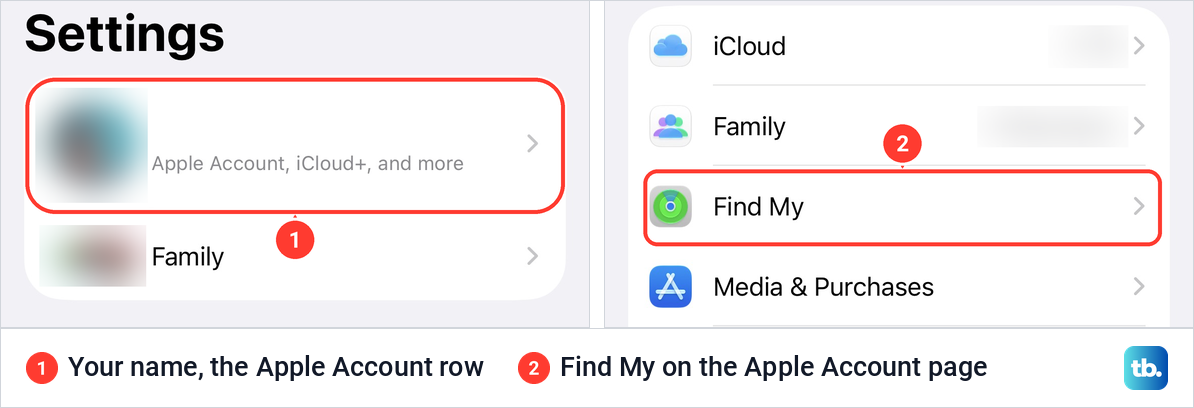
Your name sits in the first row of Settings, above the line that reads Apple Account, iCloud+, and more. On the Apple Account page, Find My is in the second group, between Family and Media & Purchases. The Find My page behind it holds both Find My iPhone and Share My Location, which are separate switches.
On our iPhone 17 Pro on iOS 26.6, the Find My iPhone page had three switches: Find My iPhone, Find My network and Send Last Location. The text under the first reads "Locate, lock, or erase this device and supported accessories. This device cannot be erased and reactivated without your password." That second sentence is Activation Lock in plain words.
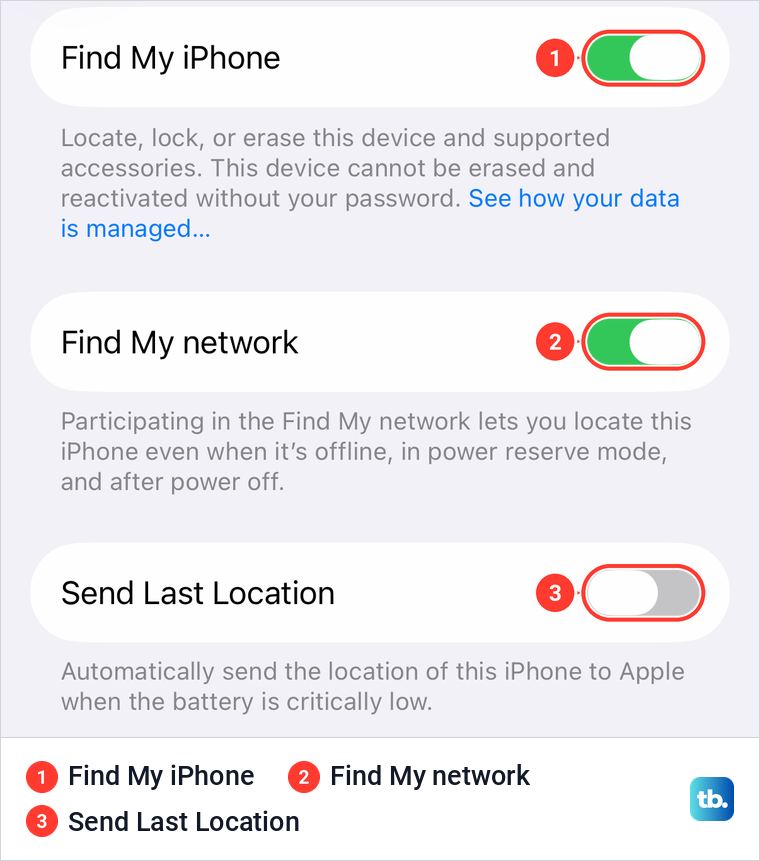
The other two switches sit under Find My iPhone on the same page. Find My network, on for us, lets you locate the iPhone "even when it's offline, in power reserve mode, and after power off", the page says. Send Last Location, off on our phone, sends the location to Apple when the battery is critically low. Apple's setup guide describes both as extras you turn on after Find My iPhone.
What changes when Find My iPhone is off
Apple says Activation Lock is removed automatically when you turn off Find My on your iPhone. That lock is what stops anyone else from activating the phone, even after a remote erase, so with it gone the phone can be set up on another Apple Account. The phone also drops out of the locate, lock and erase features that the switch's own text describes.
Erasing the phone is a separate step in Apple's selling checklist, covered below. To use Find My again later, follow the same path and turn the switch back on.
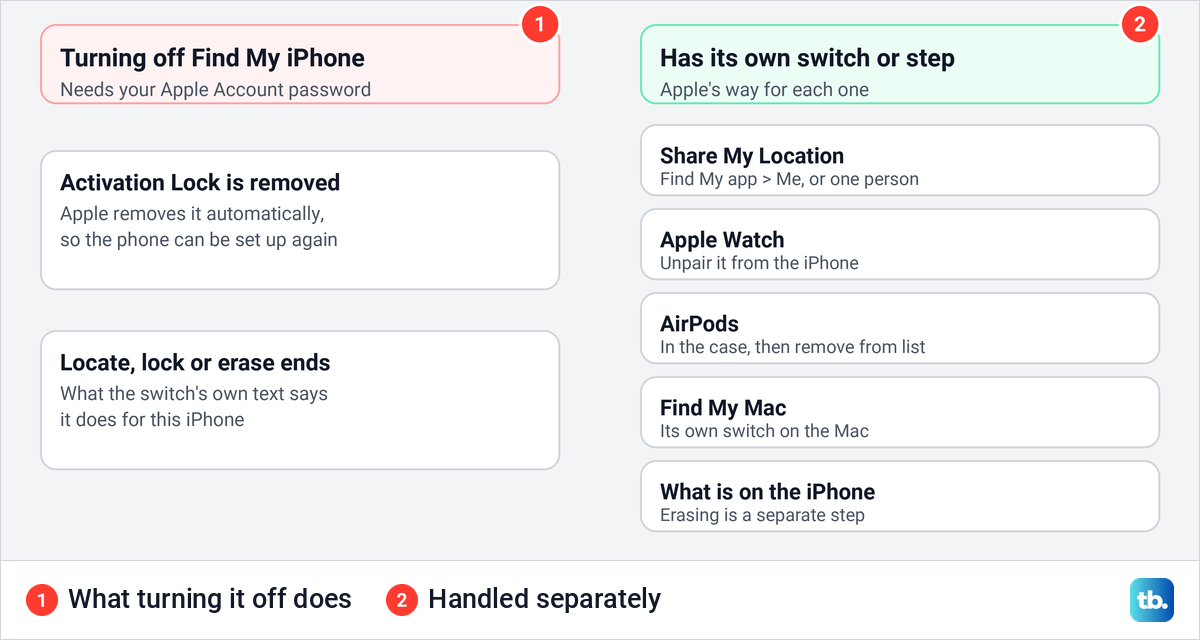
Apple handles other devices separately. Its way to take an Apple Watch out of Find My is to unpair it from the iPhone, and AirPods come off the list when you put them in their case or turn them off and then remove them. A Mac has its own Find My Mac switch, turned off on the Mac itself.
If the Find My iPhone switch will not turn off
Stolen Device Protection is the first thing to check. Apple's support page is blunt about it: you need Find My turned on for Stolen Device Protection, and "you can't turn it off while Stolen Device Protection is enabled." Apple adds that Stolen Device Protection might be turned on by default, so check it even if you never set it up yourself.
To turn off Stolen Device Protection, open Settings, tap Face ID & Passcode (Touch ID & Passcode on an iPhone with a Home button) and enter your passcode. Scroll down, tap Stolen Device Protection and turn it off. Then go back to the Find My iPhone switch.
Where you are decides how long that takes. If the setting is Away from Familiar Locations and you are not at home or work, or it is set to Always, Apple requires a Security Delay: tap Start Security Delay, pass Face ID or Touch ID, wait an hour, then pass it again. Apple says the iPhone may end the delay early once it detects that you have arrived at a familiar place.
If your name at the top of Settings is greyed out, Apple says you might have Screen Time restrictions enabled. Apple's fix for a greyed-out Apple Account is to open Settings, tap Screen Time, then Content & Privacy Restrictions. If All Restrictions is on, scroll down to Privacy Restrictions, tap Allow Changes to Settings, tap Accounts and set it to Allow, entering the Screen Time passcode if asked.
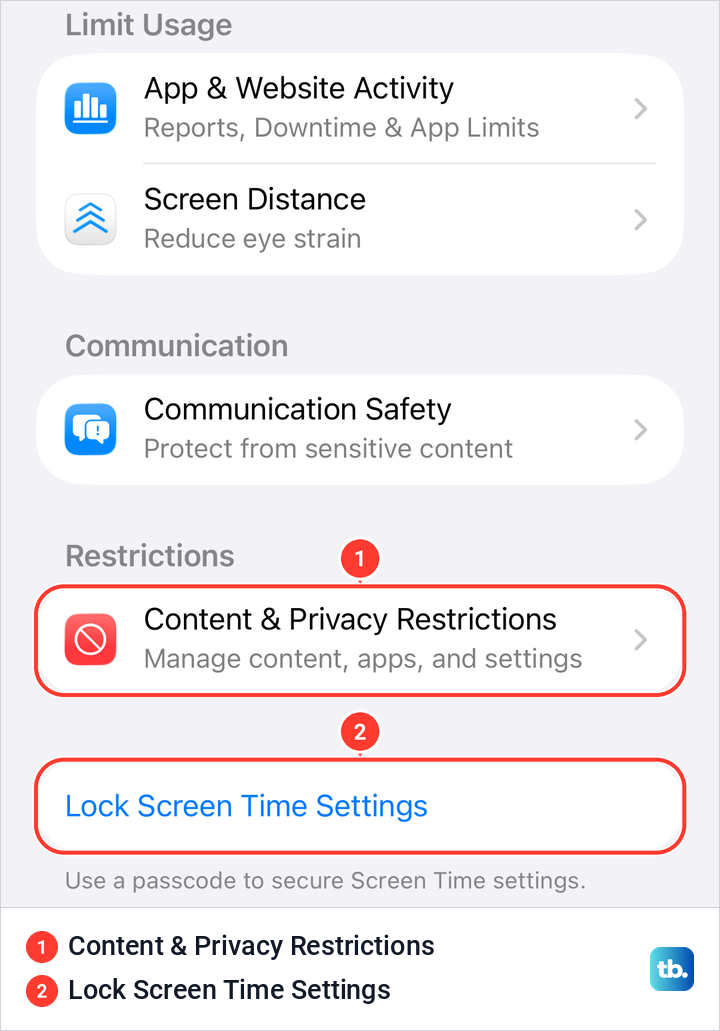
On iOS 26.5, Screen Time lists Content & Privacy Restrictions under a Restrictions heading, with Lock Screen Time Settings below it and a note to "Use a passcode to secure Screen Time settings". On a child's phone, Apple says a child in a Family Sharing group has to ask the parent or guardian to enter that passcode, and its Activation Lock page tells owners of a business or school phone to contact the IT department or manager.
Turn off Find My iPhone from a computer
If the iPhone is lost or stolen, do not remove it. Apple says removing a device from your Find My list removes Activation Lock, which makes it easier for a thief to unlock and resell it, so mark it as lost instead, and our guide shows how to use Find My iPhone on a computer for that. With AppleCare+ with Theft and Loss, Apple also says to keep the iPhone in Find My and your Apple Account until the claim is fully approved.
When the phone is broken, switched off for good or no longer yours, use a browser. Go to icloud.com/find and sign in with your Apple Account; Apple's tip is that the Find Devices button at the bottom of the sign-in window skips the two-factor code, which matters if the missing iPhone was your trusted device. Select the iPhone, then select Remove This Device.
What happens next depends on whether the phone is online, Apple's iCloud guide says. Offline, Activation Lock is removed immediately and the phone is removed from Find My after 30 days. Online, it cannot be removed, but if you select Continue it is marked as Ready for Repair or Trade In for the next 30 days. Some guides still call the button Remove from Account, but on iCloud.com it is Remove This Device.
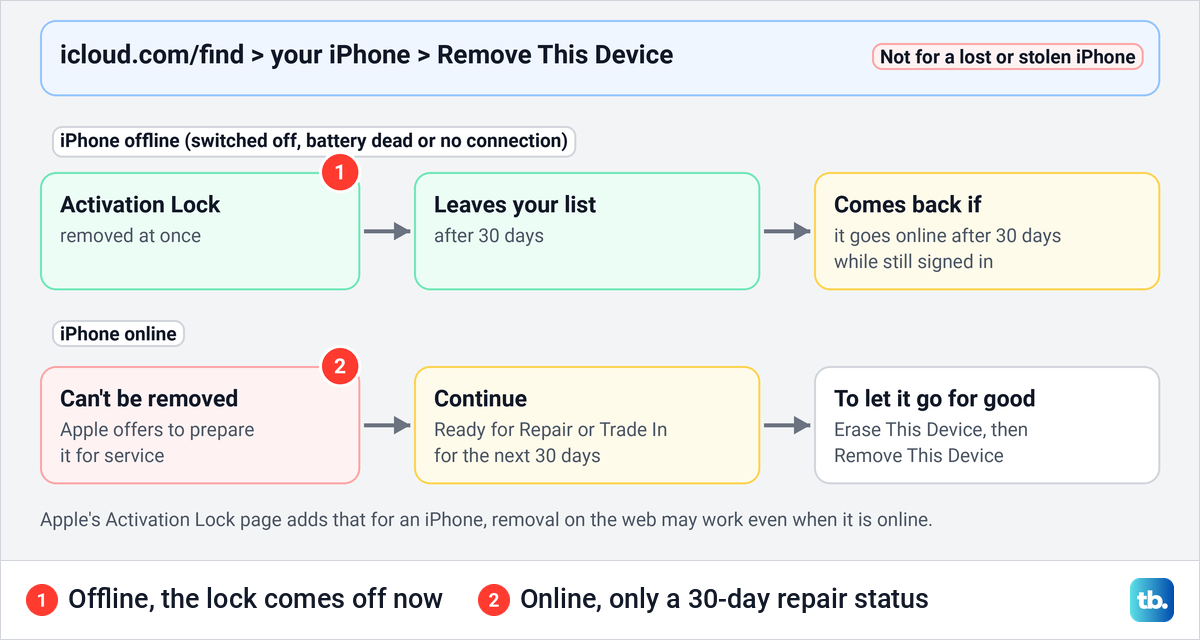
An offline phone can come back. If it comes online after the 30 days and is still signed in to your Apple Account, Apple says it reappears in your list and Activation Lock is turned on again. Apple's Activation Lock article adds that for an iPhone, removing the lock on the web might work even when the phone is online.
Remove Activation Lock from an iPhone you sold or gave away
Forgot to turn Find My off before handing the phone over? Apple's fix on iCloud.com is to select the iPhone and erase it first, leaving the phone number and message empty because the device is not lost. If it is offline, the erase starts the next time it connects, and Apple emails you once it is done.
When the erase has finished, select Remove This Device. Apple says Activation Lock is then removed immediately, the phone leaves Find My at once and someone else can activate it. Erasing alone is not enough, because after a remote erase Activation Lock stays on and your Apple Account and password are still needed to reactivate the phone.
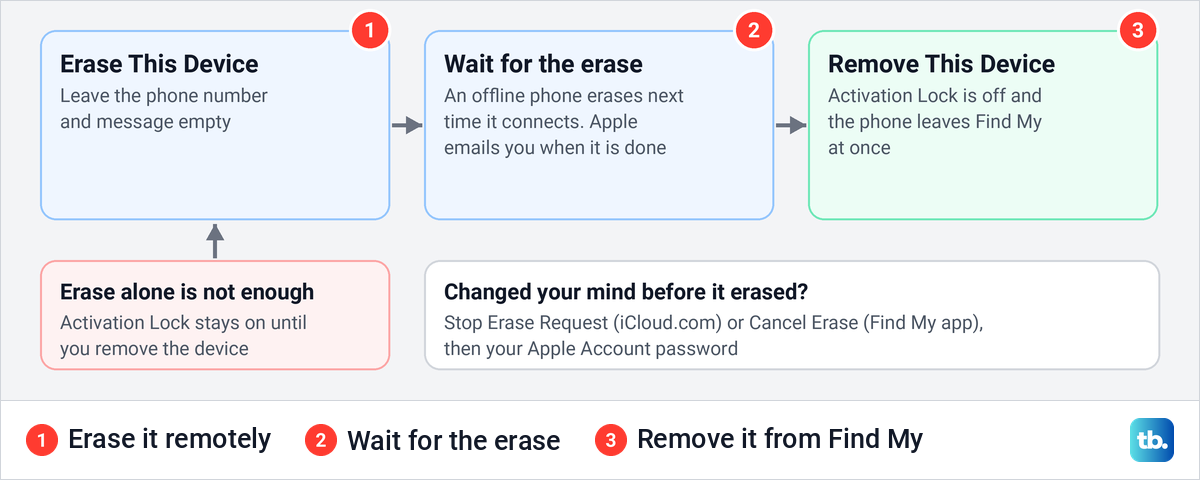
A pending erase can still be stopped: select Stop Erase Request on iCloud.com and enter your Apple Account password. Apple's other advice for a phone you no longer have is to ask the new owner to erase it and to change your Apple Account password, so the new owner cannot delete your information from iCloud.
Use the Find My app on another iPhone, iPad or Mac
Another Apple device signed in to the same account can do the same jobs. On an iPhone or iPad, Apple's steps are to tap Devices, tap the phone's name, tap the More button and tap Remove, and Apple notes the device may need to be offline. For a phone you have handed on, erase it from the same card without a phone number or message, then tap Remove This Device and Remove.
The app's erase asks for your Apple Account password and shows Erase Pending while the phone is offline. On a Mac, Apple's steps are to click Devices, select the phone, click the More button and, in the Settings section, click Remove, which works only while the phone is offline and takes effect after 30 days.
Before you sell, give away or trade in your iPhone
Apple's order for a phone you are passing on is to back up, unpair any Apple Watch, sign out and erase. Unpairing takes the Watch out of Find My, and you can pair your Apple Watch with a new iPhone later. Back up first, and if your iPhone will not back up to iCloud, fix that before you erase anything. Apple also says to turn off Stolen Device Protection before you sell, give away or trade in the phone.
On iOS 26 and later, Sign Out at the bottom of your Apple Account page asks you to choose Erase this iPhone or Sign Out But Don't Erase. Apple says the second keeps most data on the phone, including Health, Passwords, Contacts, Photos and Notes, so pick Erase this iPhone for a phone that is leaving you. Signing out also takes the phone off Find My, and our guide explains how to remove an iPhone from your Apple Account.
Erasing is the step that does the Find My work for you. Apple says that when you erase the iPhone, Find My and Activation Lock turn off, and you might be asked for your Apple Account password. On our iPhone 17 Pro on iOS 26.6, Settings > General > Transfer or Reset iPhone showed Prepare for New iPhone at the top and Erase All Content and Settings near the bottom, between Reset and Transfer to Android.
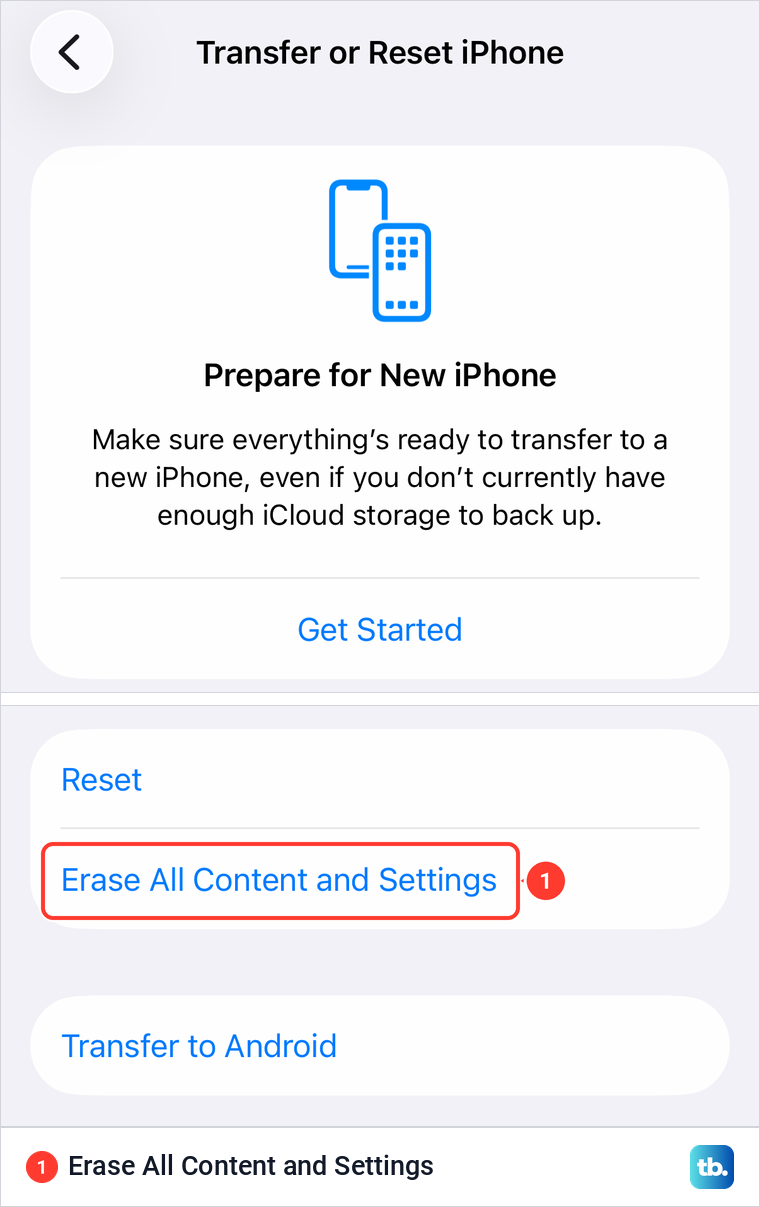
Apple's steps from there are to tap Erase All Content and Settings, tap Continue, choose to erase the eSIM too if you are selling a phone that uses one, then enter the device passcode and your Apple Account password. If you forgot your iPhone passcode, sort that out first. Our guide on how to erase your iPhone before you sell it walks through the erase step by step.
The buyer can check your work. Apple says a phone still protected by Activation Lock shows an "iPhone Locked to Owner" screen when it starts, while a phone that is ready to use shows the Hello screen. If the buyer is asked for your account, Apple's advice is that you remove the device from your account in a browser.
A trade in on iOS 27 or later can work differently. Apple's Ready for Repair or Trade In page covers eligible trade ins as well as repairs, and Apple or the Authorized Service Provider tells you whether you can use it.
Before you send your iPhone for repair
Apple changed this step with iOS 27, so start by checking your version in Settings > General > About. On iOS 26 or earlier, Apple's service page says to turn Find My off, and warns that it might not be able to service the device otherwise. On iOS 27 or later, it says to turn on Ready for Repair or Trade In instead, for repairs that qualify.
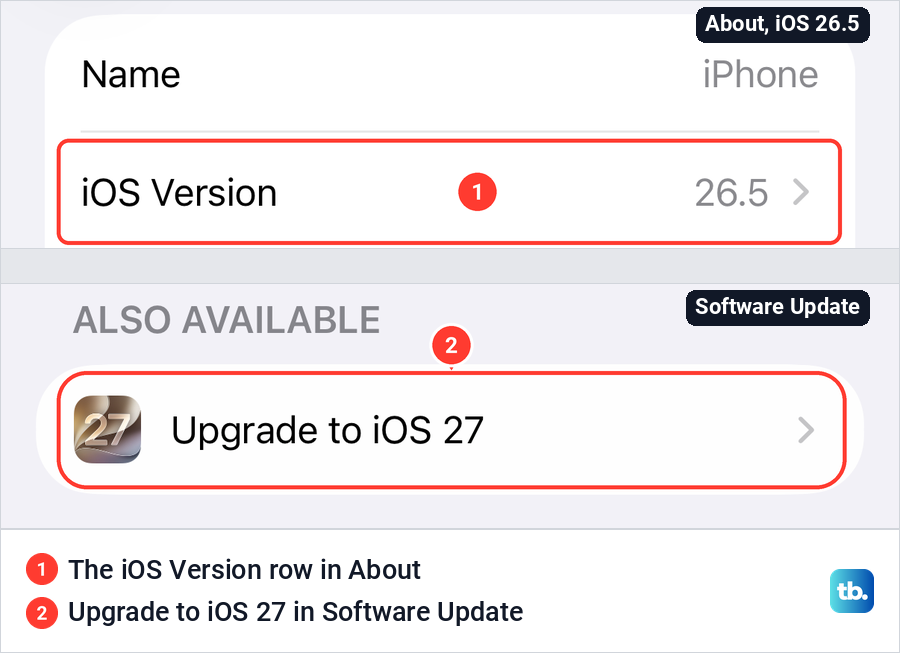
The About screen shows it on the iOS Version row (26.5 in our screenshot). On our iPhone 17 Pro on iOS 26.6, Software Update already listed Upgrade to iOS 27 under Also Available, so a phone can be one tap away from the new rule. If yours shows no such offer, check which iPhones can run iOS 27.
On iOS 27 or later, Apple's steps are to open the Find My app, select the iPhone, tap the More button, tap Repair or Trade In, tap Enable and enter your Apple Account password. Apple says this keeps Find My on throughout an eligible repair, and that the status turns off by itself once the technician marks the repair complete. The same setting is at icloud.com/find, where you select the device, click Repair or Trade In, then Enable.
Eligibility is the catch. Apple says Apple or the Authorized Service Provider will tell you whether you can use Ready for Repair or Trade In for your repair, and for an iPhone it describes the setting as part of preparing for in-person service.
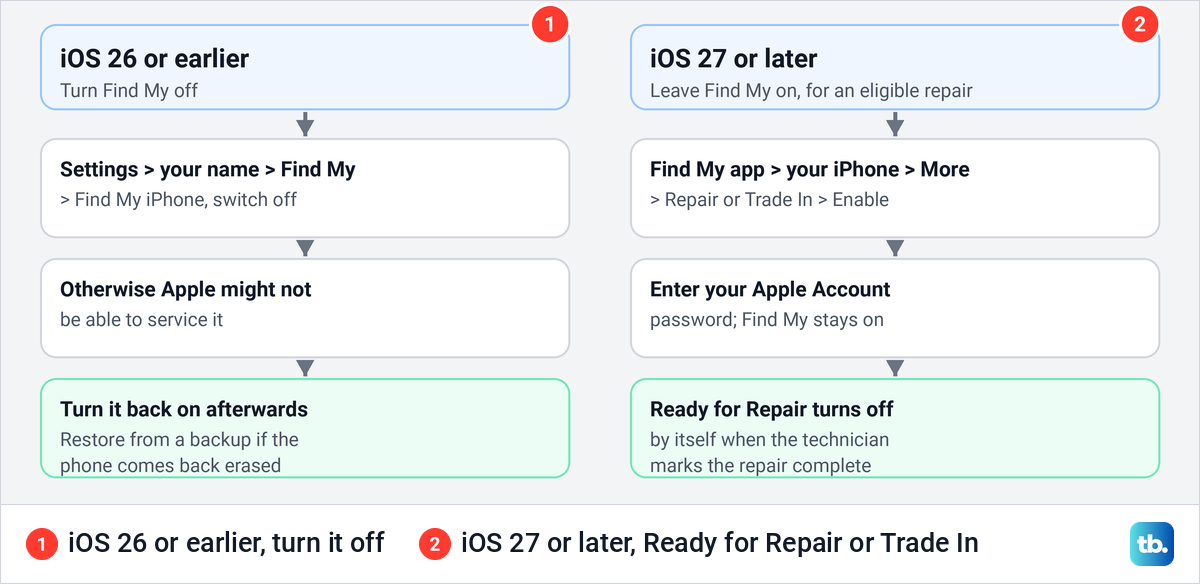
If you cannot turn Find My off on an older version, Apple's fallback is the Find My app on another device or icloud.com/find, where you select the iPhone, then Repair or Trade In or Remove This Device, and follow the instructions. Apple adds that neither it nor its Authorized Service Providers will ask for your Apple Account password or passcode.
When the phone comes back, turn Find My on again if you switched it off. Apple warns the phone might have been erased, in which case you restore your iPhone from a backup or set it up as new.
If you only want to stop sharing your location
If you only want to stop someone seeing where you are, that is a different switch. Apple's steps are to open the Find My app, tap Me and turn off Share My Location, or tap People, pick one person and tap Stop Sharing My Location. Apple says the person you stop sharing with is not notified, though they may notice, and that deleting the Find My app does not stop sharing.
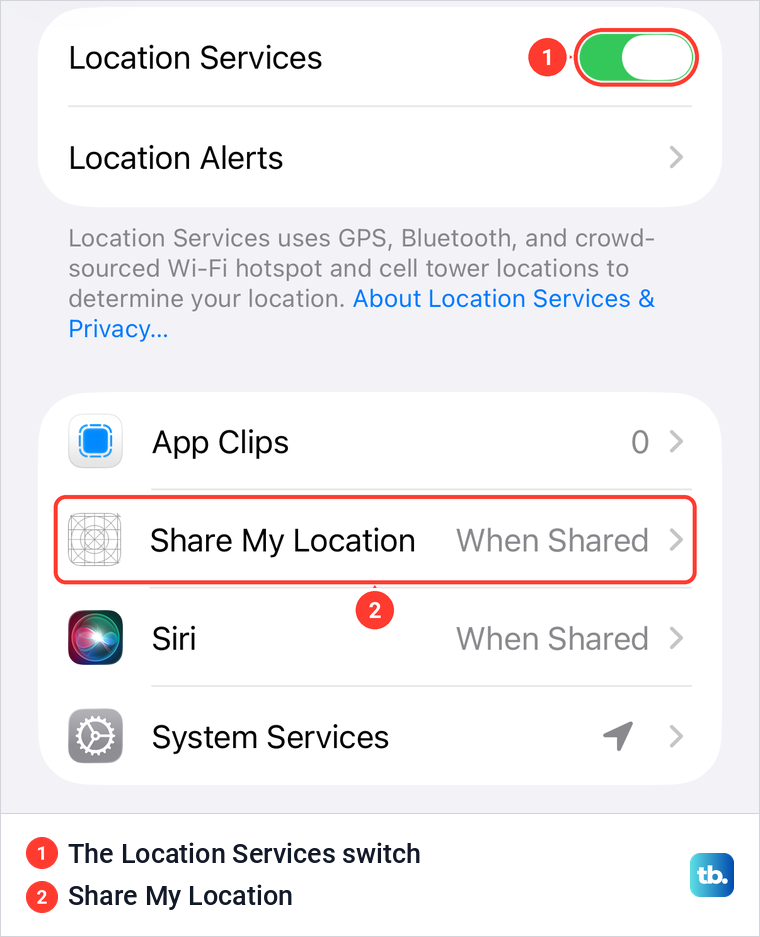
Share My Location also has a row under Settings > Privacy & Security > Location Services, where on iOS 26.5 it read When Shared. The switch at the top of that page is Location Services itself, and our guide to Location Services on iPhone explains what it controls. Our guide on how to share or stop sharing your location covers Messages and Maps as well, and Apple points anyone whose safety is at risk to Safety Check.
If you forgot your Apple Account password
Turning Find My off needs the Apple Account password, so reset it first. Apple's easiest route is on the iPhone itself: Settings, your name, Sign-In & Security, Change Password, then your device passcode and the onscreen steps. Apple says you might have to wait an hour before changing it, and changing the password is one of the actions Stolen Device Protection can put behind its Security Delay.
Away from your devices, Apple says you can change the password at iforgot.apple.com, and our guide shows how to reset your Apple Account password on the web. If none of that works and you have proof of purchase, Apple's last resort is an Activation Lock support request, which you start from Apple's page on how to remove Activation Lock.
How we tested this guide
We tested this on an iPhone 17 Pro on iOS 26.6, going through the Find My iPhone page and Transfer or Reset iPhone.
Frequently Asked Questions
Why can't I turn off Find My iPhone?
Check Stolen Device Protection first, because Apple does not allow Find My to be turned off while it is enabled. Turn it off in Settings > Face ID & Passcode, which away from home or work, or with it set to Always, can mean a one-hour Security Delay. If your name at the top of Settings is greyed out, a Screen Time restriction on Accounts can be the cause, and on a child's phone the parent's Screen Time passcode is needed.
Can I turn off Find My iPhone from a computer?
Yes, for a phone that is broken or no longer yours. At icloud.com/find, Remove This Device takes Activation Lock off at once for an offline phone, but for an online phone it only sets Ready for Repair or Trade In for 30 days. For a phone you sold, erase it first, then remove it, and for a lost or stolen phone, Apple says to mark it as lost and not remove it.
How do I turn off Find My on an iPhone I already sold?
On icloud.com/find or in the Find My app, erase the iPhone without a phone number or message, wait for the erase, then choose Remove This Device. Erasing alone leaves Activation Lock on.
Do I need to turn off Find My before a repair?
On iOS 26 or earlier, yes, because Apple says it might not be able to service the phone otherwise. On iOS 27 or later, turn on Ready for Repair or Trade In in the Find My app instead, which keeps Find My on during an eligible repair; Apple or the service provider tells you whether yours qualifies.
Does erasing my iPhone turn off Find My?
Yes. Apple says Find My and Activation Lock turn off when you erase the iPhone with Erase All Content and Settings, and you might be asked for your Apple Account password.
Will turning off Find My stop people seeing my location?
If hiding your location is the goal, turn off Share My Location in the Find My app's Me tab instead, which leaves Find My iPhone alone. When you stop sharing with one person, Apple says they are not notified.